
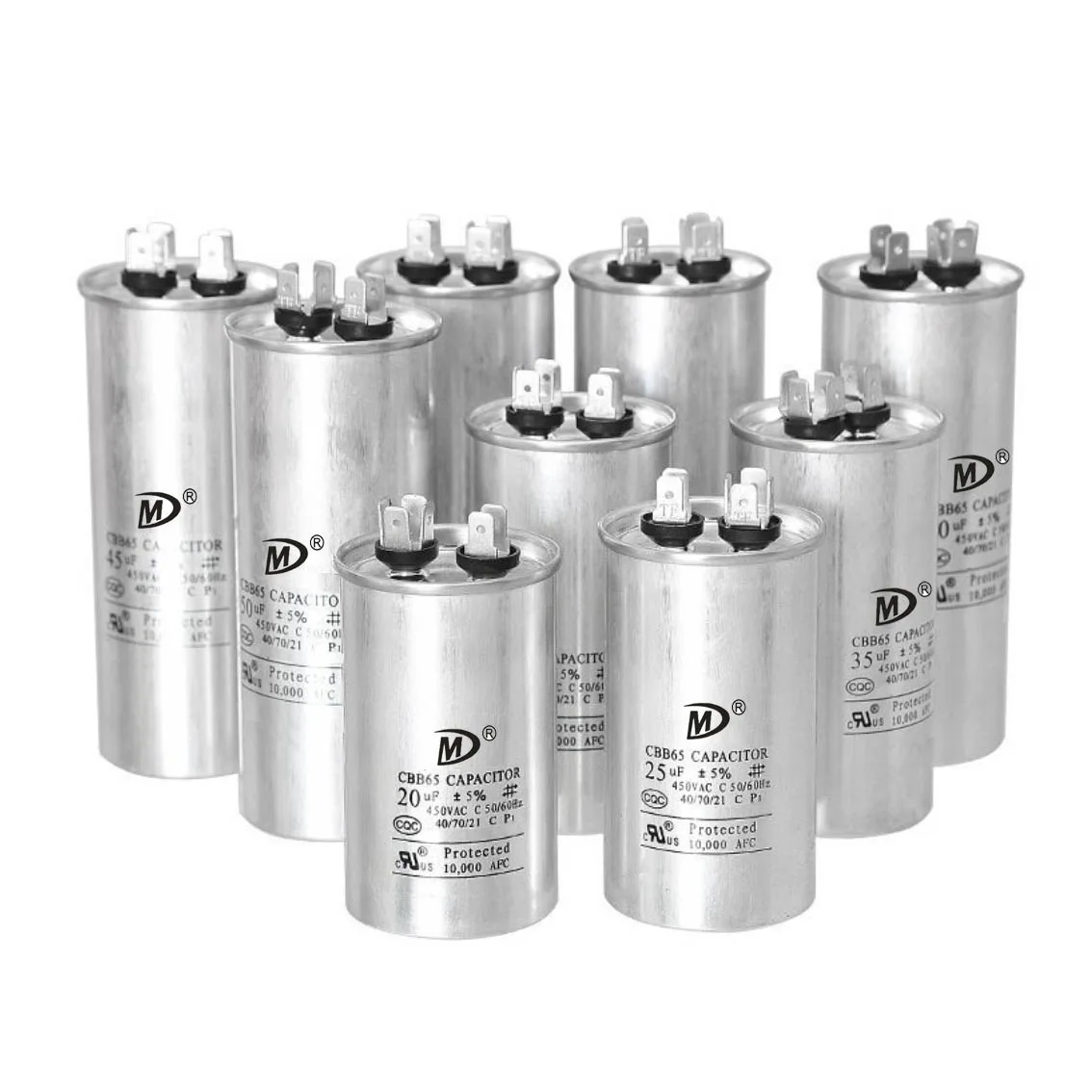
If you're designing or sourcing for HVAC compressors, you've likely faced the two-capacitor problem: one run capacitor for the compressor (HERM) and another for the condenser fan (FAN). The dual-run cbb65 capacitor solves it by packing both sections into a single P2 explosion-proof aluminum can. With common ratings like 35+5µF and 30+5µF at 400V or 450V AC, these dual-section parts cut BOM count, simplify wiring, and shrink the control box footprint. Here's how they work, where oval and round footprints fit, and what OEM-grade screening should look like.
What Dual-Run CBB65 Means: C, HERM, and FAN in One Can
A dual-run CBB65 is a metallized polypropylene film capacitor with two electrically independent sections sharing one aluminum housing. The terminals are typically labeled C (common), HERM (compressor run), and FAN (condenser fan run). The C terminal is the common node; HERM feeds the compressor run winding, and FAN feeds the fan motor run winding. Internally, two separate wound elements sit in the same oil-filled or resin-filled can, each with its own self-healing metallized film and safety mechanism.
This architecture matters because the compressor and fan see different duty cycles. The compressor section carries higher inrush and continuous current; the fan section runs lighter but often continuously. By keeping the sections independent, a dual-run CBB65 lets you size each section to its load without adding a second can, bracket, or wire harness. For a 35+5µF part, the 35µF section handles the compressor and the 5µF section handles the fan. The 30+5µF variant follows the same logic for smaller compressors.
The P2 designation refers to the explosion-proof safety class. CBB65 capacitors are built with an overpressure disconnection mechanism: if internal pressure rises under fault conditions, the can deforms and breaks the internal connection before rupture. That's the P2 behavior you want in a sealed HVAC control box. It's not a cosmetic feature; it's a safety layer that protects the compressor circuit and the surrounding wiring.
Oval vs Round Footprints: Fitting the Control Box
Dual-run CBB65 capacitors come in two dominant can shapes: oval and round. The choice is usually driven by the existing bracket and airflow path in the outdoor unit, not by electrical performance. Both shapes use the same metallized film elements and P2 safety mechanism; the difference is packaging and mounting.
Oval cans are common in residential split systems where the control box is shallow and wide. They slide into stamped metal brackets and leave room for contactors and terminal blocks. Round cans are often found in larger commercial units or where a circular clamp mount is preferred. If you're retrofitting a dual-run part into an existing platform, match the can shape and terminal spacing first, then confirm the capacitance and voltage rating. A 35+5µF oval won't drop into a round clamp without a bracket change.
Terminal configuration also varies. Most dual-run CBB65 parts use 1/4-inch quick-connect spade terminals, but some OEMs specify different blade sizes or a combination of spade and wire leads. When you specify a dual-run part, lock down the terminal map: which blade is C, which is HERM, and which is FAN. Miswiring a dual-run capacitor is a common field failure, and clear terminal marking is part of good OEM screening.
Voltage Ratings: 400V AC vs 450V AC
Dual-run CBB65 capacitors are typically rated at 400V AC or 450V AC, 50/60Hz. The rating you choose depends on the compressor's running voltage and the margin your design needs. A 450V AC part gives more headroom for high-line conditions and voltage transients; a 400V AC part may be sufficient for regulated supplies with tight tolerances.
Don't treat the voltage rating as a nominal operating point. It's a maximum continuous AC voltage rating at the specified frequency and temperature. If your compressor sees sustained high-line voltage or the capacitor sits in a hot corner of the control box, the 450V AC part is the safer choice. The capacitance tolerance is typically ±5% (J) or ±10% (K), and the dissipation factor for CBB65 is ≤0.0025, which keeps losses low in continuous fan duty.
For a hypothetical 3-ton residential condensing unit running a 35+5µF dual-run capacitor, the compressor section might see 35µF at 450V AC while the fan section sees 5µF at the same rating. If the same platform is sold into regions with 400V AC nominal, the 400V AC variant may be acceptable, but you'll want to verify the high-line margin. The point is to match the rating to the worst-case voltage, not the nameplate average.
Class A Life and OEM Quality Screening
CBB65 capacitors are classified by life expectancy: Class A (30,000 hours), Class B (10,000 hours), and Class C (3,000 hours). For HVAC compressors, Class A is the baseline you should specify. A 30,000-hour rating at rated voltage and temperature gives you a realistic service life for residential and light commercial equipment, assuming the capacitor isn't run beyond its ratings.
Life class alone doesn't guarantee field reliability. OEM quality screening is what separates a commodity part from a compressor-grade capacitor. At a minimum, look for automated AC/DC empowerment, DC withstand voltage testing, and leak testing on every batch. A dedicated QA/QC team and in-house lab should be checking capacitance, dissipation factor, and insulation resistance against the specification. SMILER, for example, operates under ISO9001:2005 and holds TUV (R 50352497 0002), VDE (40034278), CB (CN36735, CN65200), LVD (AN 50706408 0001), and RoHS (CANEC26003636901) certifications, with SGS on-site verification (489624232_P+T). Those certificates don't replace incoming inspection, but they do confirm the quality system behind the part.
Ask for the terminal map, the can dimensions, and the mounting bracket drawing before you approve a dual-run CBB65. A capacitor that fits electrically but not mechanically will stall your line. You can review the CBB65 HVAC compressor capacitor specifications for baseline dimensions and ratings, and check the quality process for screening details.
Specification Comparison: Dual-Run CBB65 Variants
The table below compares common dual-run configurations and related single-section parts. Use it as a starting point for your own specification, not as a substitute for the datasheet.
| Parameter | Dual-Run 35+5µF | Dual-Run 30+5µF | Single-Section CBB65 |
|---|---|---|---|
| Configuration | C / HERM / FAN | C / HERM / FAN | Two terminals |
| Capacitance | 35µF + 5µF | 30µF + 5µF | 3µF – 100µF |
| Voltage Rating | 400V / 450V AC, 50/60Hz | 400V / 450V AC, 50/60Hz | 450V AC, 50/60Hz |
| Tolerance | ±5% (J) / ±10% (K) | ±5% (J) / ±10% (K) | ±5% (J) / ±10% (K) |
| Can Shape | Oval or round | Oval or round | Oval or round |
| Safety Class | P2 explosion-proof | P2 explosion-proof | P2 explosion-proof |
| Life Class | A (30,000h) | A (30,000h) | A (30,000h) |
| Dissipation Factor | ≤0.0025 | ≤0.0025 | ≤0.0025 |
| Typical Application | Residential/light commercial compressor + fan | Smaller compressor + fan | Compressor or fan only |
If your platform uses a 30+5µF dual-run part, confirm the compressor's locked-rotor and running current against the capacitor's ripple current capability. The 5µF fan section is usually the easier half; the compressor section drives the thermal design.
Application Notes for HVAC Designers
Dual-run CBB65 capacitors are used across central air conditioners, split systems, heat pumps, and commercial refrigeration. The compressor section handles the HERM winding; the fan section handles the condenser fan motor. In heat pump reversing valves and variable-speed systems, the capacitor still provides the run capacitance for the fixed-speed compressor and fan, while the inverter or control board manages modulation.
Mounting matters. Keep the capacitor away from hot discharge lines and ensure the bracket doesn't compress the can. The P2 safety mechanism relies on the can being able to deform; a tight or distorted bracket can interfere with that behavior. Also check the terminal orientation: some control boxes route wires from the top, others from the side. A dual-run part with the wrong terminal orientation will force a harness redesign.
For OEM programs, request sample lead time and mass production lead time early. SMILER's SGS-verified records show a shortest sample lead time of 5 days and an average mass production lead time of 15 days, supported by 9 automated production lines and up to 300,000 units daily output. That capacity matters when you're ramping a new HVAC platform across multiple SKUs. You can see related use cases on the applications page.
Frequently Asked Questions
Can I replace two separate run capacitors with one dual-run CBB65?
Yes, if the capacitance values and voltage ratings match the original compressor and fan sections, and the can fits your bracket. A 35+5µF dual-run part replaces a 35µF compressor capacitor and a 5µF fan capacitor. Verify the terminal map (C, HERM, FAN) and confirm the P2 safety class before you swap. If the original fan capacitor was a different voltage rating, match the higher rating or confirm the fan motor's requirements.
What's the difference between 400V AC and 450V AC dual-run CBB65 capacitors?
The difference is the maximum continuous AC voltage rating. A 450V AC part gives more margin for high-line conditions and transients; a 400V AC part is suitable for regulated supplies with tighter voltage tolerance. Choose based on the worst-case voltage your compressor and fan will see, not the nominal nameplate. Both ratings are available in 35+5µF and 30+5µF configurations.
How do I verify OEM quality screening for dual-run CBB65 capacitors?
Ask for the quality system certificates and the batch test records. Look for ISO9001:2005, TUV, VDE, CB, LVD, and RoHS documentation, plus evidence of automated AC/DC empowerment, DC withstand voltage testing, and leak testing. A dedicated QA/QC team and in-house lab should be part of the supplier's process. SMILER's certificates include TUV R 50352497 0002, VDE 40034278, CB CN36735/CN65200, LVD AN 50706408 0001, and RoHS CANEC26003636901, with SGS report 489624232_P+T.
Related Capacitor Series
Need Datasheets or Custom OEM Film Capacitors?
Send your capacitance, voltage rating, and mechanical drawing. Our 9-member engineering team replies within 24 hours with 5-day prototyping availability.